Family routines are often recommended as the solution to chaos at home. But many parents try routines that feel rigid, exhausting, or impossible to maintain. After a few days, everything falls apart — and frustration takes over.
The truth is that a routine only works when it fits real life. A successful family routine is flexible, simple, and supportive. It helps children feel safe and cooperative, and it helps adults feel less overwhelmed — not more controlled.
In this article, you’ll learn how to build a family routine that truly works in everyday life, without turning your home into a military camp or draining your emotional energy.
Why Routines Are So Important for Children
Children feel safer when life is predictable. They don’t need strict schedules, but they do need to know what usually happens next.
A well-built routine helps children:
- Reduce anxiety and emotional overload
- Transition more easily between activities
- Cooperate more naturally
- Develop independence
- Regulate emotions more effectively
For adults, routines reduce constant decision-making and repeated negotiations.
Instead of arguing about every step of the day, the routine becomes the guide.
A Working Routine Is a Rhythm, Not a Schedule
One of the biggest mistakes parents make is trying to follow routines by the clock.
A routine that depends on exact times often collapses when:
- The day runs late
- A child is tired or emotional
- Plans change unexpectedly
What works better is rhythm.
Rhythm is about order, not time.
For example:
- After breakfast → get dressed
- After school → snack and decompress
- After dinner → calm activities
- After pajamas → story and bed
This creates predictability without pressure.
Start with One Problem Area Only
Trying to fix the entire day at once usually leads to burnout.
Instead, identify one part of the day that causes the most stress.
Common examples:
- Mornings
- After-school time
- Bedtime
Choose only one routine to work on first. When that routine improves, the rest of the day often becomes easier naturally.
Keep the Routine Short and Clear
If a routine has too many steps, children resist and adults get exhausted.
A strong routine usually has three to five steps.
For example, a bedtime routine:
- Bathroom and pajamas
- Teeth brushing
- Story
- Goodnight and lights out
That’s enough.
The power of a routine comes from repetition, not complexity.
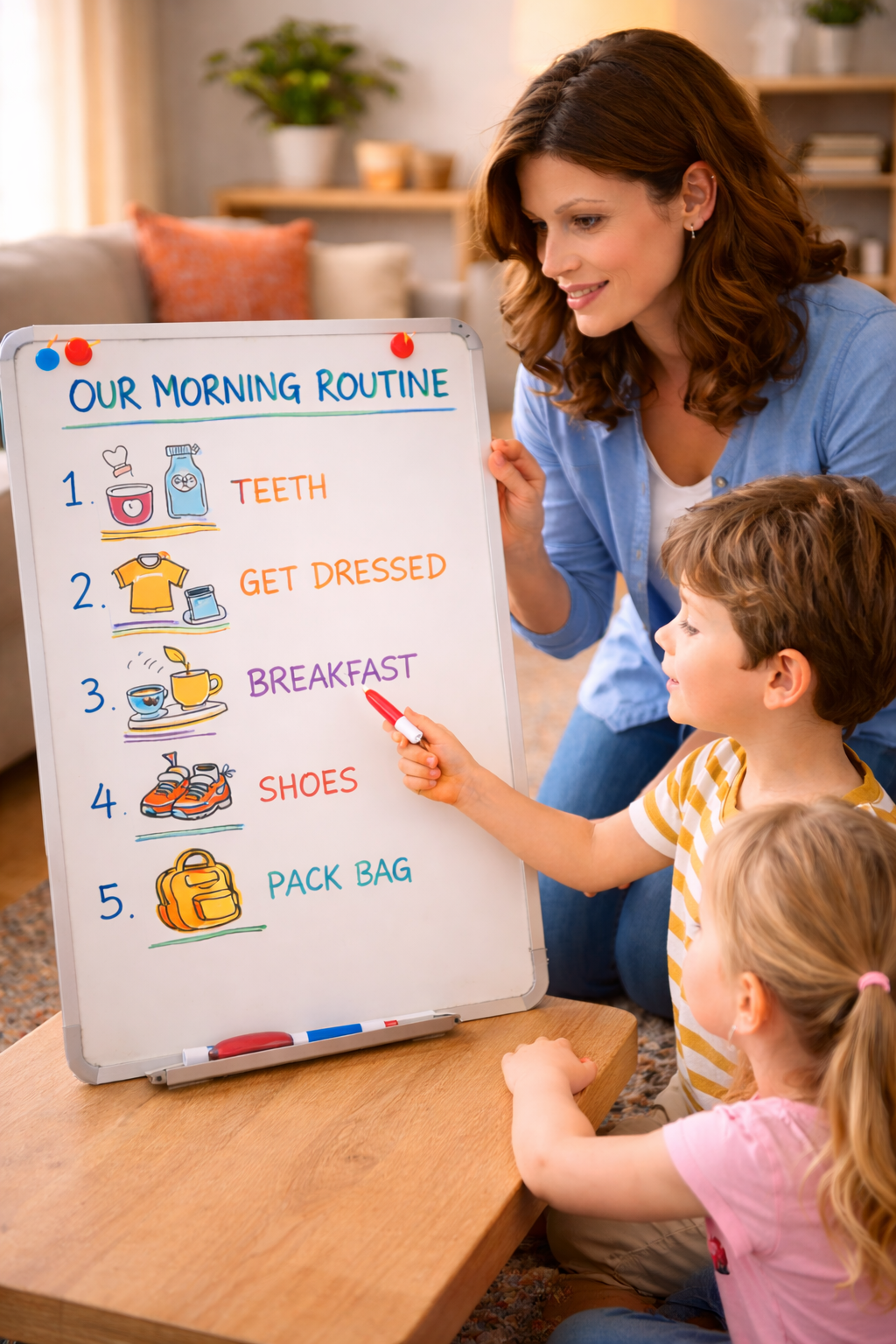
Make the Routine Visible
Children don’t ignore routines on purpose — they often forget them, especially when tired or excited.
Visual reminders reduce power struggles.
Helpful options include:
- A simple checklist
- A small routine chart
- A whiteboard with steps
This allows you to point to the routine instead of repeating instructions constantly.
Involve Your Child in the Process
Children cooperate more when they feel included.
You don’t need to give control — just meaningful choices.
Examples:
- “Do you want to brush teeth before or after pajamas?”
- “Should we clean up before dinner or after?”
This creates ownership while keeping adult leadership.
Use Transitions to Make or Break the Routine
Most conflicts happen during transitions, not activities.
Support transitions by:
- Giving warnings (“Five more minutes”)
- Using consistent phrases (“Time to switch”)
- Staying calm and repetitive
Avoid sudden changes whenever possible.
Predictable transitions reduce emotional explosions.
Add Connection Before the Hardest Step
If your child always resists a certain part of the routine, connection may be missing.
Before the hardest step, add a short connection moment:
- A hug
- Two minutes of talking
- A short game
This is not a reward — it’s emotional regulation.
Children cooperate better when they feel emotionally filled.
Reduce Daily Negotiations
Routines fail when everything is negotiable.
Reduce negotiation by:
- Limiting choices
- Repeating the same sequence daily
- Using calm, short language
For example:
“Pajamas time. Do you want the blue or green ones?”
Avoid explaining the rule repeatedly. Consistency teaches faster than arguments.
Build a “Low-Energy Version” of the Routine
Some days are harder than others.
If your routine only works on good days, it won’t last.
Create a minimum routine you can follow even when everyone is tired.
For example, bedtime minimum:
- Bathroom
- Teeth
- One short story
- Lights out
You can always add more on better days.
Use Tools Instead of Threats
Threats create fear and resistance. Tools create clarity.
Helpful tools include:
- Timers
- Songs
- Simple cues
For example:
“When the timer rings, we clean up.”
Then follow through calmly.
Teach Independence Through the Routine
Routines are perfect for teaching independence gradually.
Add one responsibility at a time, such as:
- Putting shoes away
- Hanging a backpack
- Packing part of lunch
Don’t add too many skills at once. Progress matters more than speed.
Adjust for Different Personalities
Not all children respond to routines the same way.
Some need:
- Visual support
- Extra warnings
- More connection
Others need:
- Clear boundaries
- Fewer words
- More consistency
Fair does not mean identical.
Watch for Routine Killers
Some habits quietly destroy routines:
- Screens too late in the day
- Overpacked schedules
- Lack of sleep
- Too much clutter
Fixing just one of these can dramatically improve the routine.
When the Routine Falls Apart (and It Will)
No routine works perfectly all the time.
What matters is repair.
You can say:
- “That was a hard morning. Let’s try again tonight.”
- “I got frustrated. I’m sorry.”
Repair teaches children that routines are support tools, not punishments.
A Routine That Works Feels Supportive
A good routine:
- Reduces stress
- Improves cooperation
- Creates emotional safety
- Supports independence
It should feel like a guide, not a control system.
You don’t need perfection.
You need a rhythm your family can return to — again and again.